

Welcome to this week’s edition of AImpulse, a five point summary of the most significant advancements in the world of Artificial Intelligence.
Here’s the pulse on this week’s top stories:

1. Meta DNA Is Reshaping OpenAI
A new report from The Information reveals that one in five OpenAI employees now hail from Meta, bringing with them Facebook-era growth tactics that are reshaping the company’s culture and strategy.
The details:
Over 600 of OpenAI’s 3,000 employees are former Meta staffers, including Applications CEO Fidji Simo, with an internal Slack channel dedicated to the group.
Internal surveys reportedly asked if OpenAI was becoming “too much like Meta,” and former CTO Mira Murati is said to have left over disagreements on growth strategy.
Some teams are even exploring how ChatGPT’s memory could be used for personalized ads, an idea CEO Sam Altman once called “dystopian.”
The report also highlights internal friction around Sora 2’s rollout, with employees questioning the app’s social direction and moderation plan.
Why it matters:
OpenAI’s evolution from research lab to consumer giant is testing its identity. The influx of Meta veterans may accelerate growth, but risks diluting the startup culture that first made OpenAI distinctive.
Further reading: https://www.theinformation.com/articles/meta-hires-four-openai-researchers
2. Google Dominates Generative Media
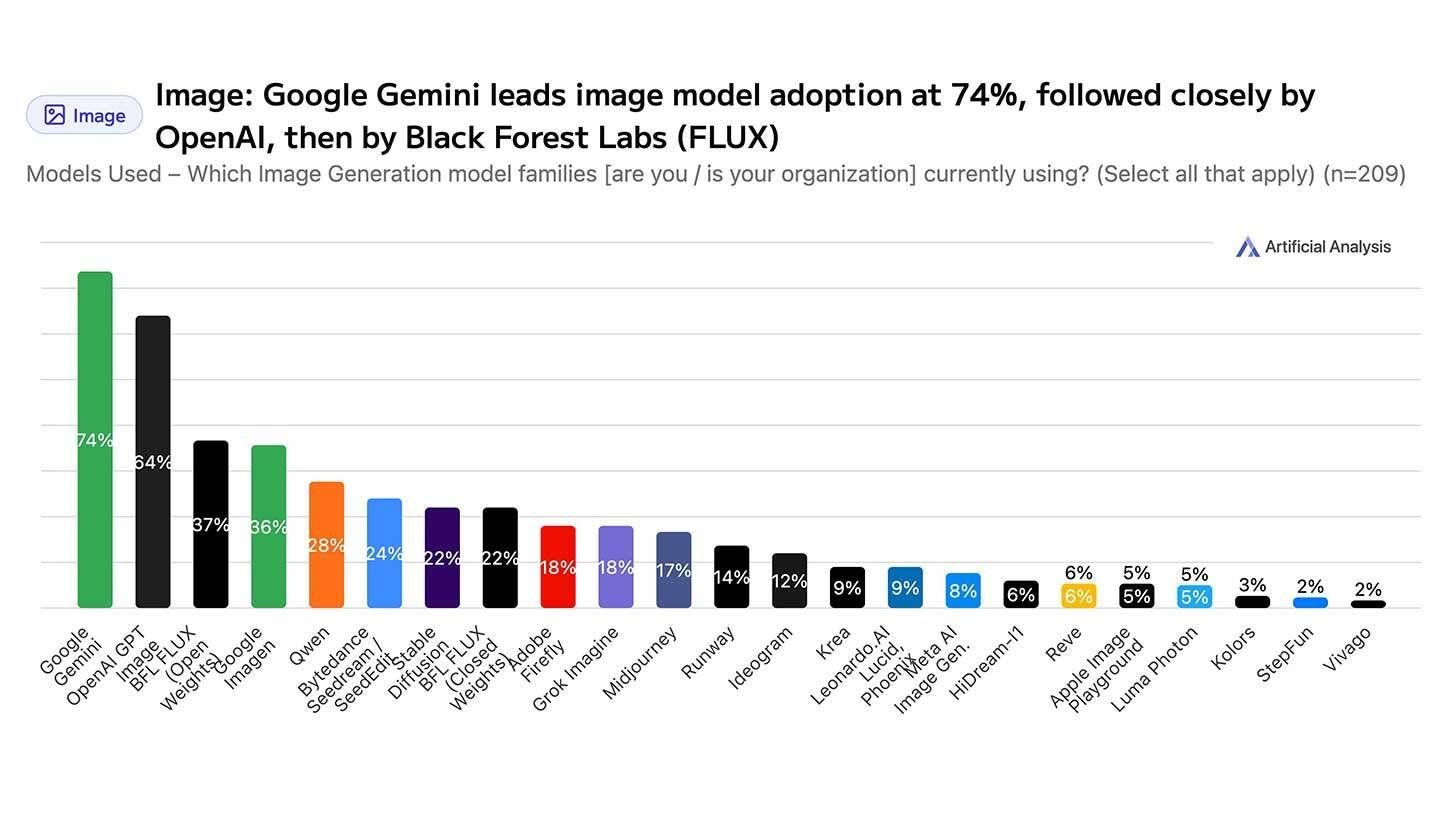
Benchmarking firm Artificial Analysis has released its 2025 State of Generative Media report, surveying 300 developers and creators on AI image and video adoption, model preferences, and ROI.
The details:
Google leads the field: Gemini accounts for 74% of AI image use, while Veo holds 69% of video creators, outpacing OpenAI, Midjourney, and Chinese rivals like Kling.
Personal creators: 89% have integrated image generation tools; only 58% use AI for video, though that figure is climbing fast.
Enterprise ROI: 65% of organizations report breaking even within 12 months; 34% are already seeing profits.
Priorities differ: Individuals rank model quality (76%) as top concern, while enterprises focus on cost savings (57%).
Why it matters:
Google’s twin dominance in AI image and video creation is reshaping the creative stack. While the sample size is small, the report’s ROI findings challenge the broader narrative that enterprise AI still struggles to pay off.
Further reading: https://artificialanalysis.ai/media/survey-2025
3. OpenAI’s Next Frontier Is Music
OpenAI is developing new AI music-generation models, enlisting students from Juilliard to annotate musical scores as it moves to challenge startups like Suno and Udio.
The details:
Juilliard students are helping create annotated datasets across instruments and genres to train OpenAI’s next-gen audio models.
The system would enable text-to-song generation, track layering, and soundtrack creation for video content.
OpenAI previously experimented with MuseNet and Jukebox (2019–2020) before shelving both projects—this marks its third attempt at AI music.
Internal discussions point to advertising agencies as early use-case partners for jingles, compositions, and style-matching soundtracks.
Why it matters:
After conquering text, images, and video, OpenAI’s “everything-AI” strategy is expanding into sound. If integrated into ChatGPT, a music model could ignite mass adoption across the AI audio industry.
Further reading: https://hypebeast.com/2025/10/openai-reportedly-developing-ai-music-generator-from-prompts
4. Netflix Goes “All In” on AI
Netflix executives used the company’s latest earnings call to announce they’re “all in” on AI—from business ops to content production—despite Hollywood’s continued unease with the tech.
The details:
Netflix plans to infuse AI across recommendations, advertising, and production workflows, claiming it’s “well positioned” for the AI era.
Several productions already use AI for age de-aging, wardrobe ideation, and set visualization.
CEO Ted Sarandos said AI will help creators “tell stories better, faster, and in new ways,” while stressing it “doesn’t automatically make you a great storyteller.”
Why it matters:
Between union disputes, creative fears, and tools like OpenAI’s Sora, AI’s arrival in entertainment has been turbulent. Yet Netflix’s embrace underscores a growing reality: the line between art and algorithm is blurring fast.
Further reading: https://techcrunch.com/2025/10/21/netflix-goes-all-in-on-generative-ai-as-entertainment-industry-remains-divided/
5. Adobe Reinvents Creativity with AI
At its MAX Conference, Adobe unveiled a sweeping wave of AI features across its creative suite, spanning assistants, model integrations, and new Firefly upgrades.
The details:
AI assistants arrive in Photoshop and Express, while an upcoming agentic system, Project Moonlight, previews autonomous creative support.
Firefly Image Model 5 introduces “Prompt-to-Edit” for conversational editing and adds AI soundtracks, voiceovers, and smart-edit tools for video.
Artists can now train custom Firefly models using their own work for personalized generations.
Partnerships with Google Cloud and YouTube integrate Gemini, Veo, and Imagen into Adobe’s ecosystem, while Premiere tools extend directly into YouTube Shorts.
Why it matters:
By opening its ecosystem to third-party models, Adobe positions itself as the creative layer for all AI platforms. Its combination of assistants, customization, and openness could future-proof its dominance in the creative industry.
Further reading: https://news.adobe.com/news/2025/10/adobe-max-2025-news