

Welcome to this week’s edition of AImpulse, a five point summary of the most significant advancements in the world of Artificial Intelligence.
Here’s the pulse on this week’s top stories:

OpenAI CEO floats AI succession plan
What’s happening
In a wide-ranging Forbes profile, Sam Altman outlined a provocative vision for OpenAI’s future, one that could eventually put an AI system in charge of the company itself.
Details
Altman said OpenAI has a succession plan to ultimately “hand off the company to an AI model,” arguing that if AGI can run companies, OpenAI should be the first test case
He claimed OpenAI has “basically built AGI,” prompting public pushback from Satya Nadella, who also described Microsoft and OpenAI as “frenemies”
Forbes reported Altman holds stakes in 500+ companies, fueling internal concern that OpenAI is moving too fast and spreading itself too thin
Altman addressed tensions with Elon Musk, criticizing Musk’s attacks on OpenAI and raising safety concerns around xAI
Why it’s important
Altman remains the most effective narrative driver in AI. His claims shape public expectations, but they also raise pressure on OpenAI to prove it can execute amid growing complexity and scrutiny.
Elon Musk merges xAI into SpaceX
What’s happening
Elon Musk announced that his AI startup xAI has been merged into SpaceX, creating what he claims is the most valuable private company ever.
Details
xAI will operate as an internal division of SpaceX, integrating Grok, rockets, and the X platform
The merger comes ahead of a potential SpaceX IPO, with Musk citing a $1.25T valuation
Musk outlined plans for space-based AI data centers, arguing orbital solar energy solves Earth’s power constraints
He claimed space compute could be cheaper than terrestrial data centers within 2–3 years
Long-term vision includes self-sustaining Moon bases, a Mars civilization, and broader cosmic expansion
Why it’s important
This move accelerates Musk’s vertical integration strategy. While orbital data centers sound extreme, SpaceX uniquely positions him to actually attempt it, and potentially redefine AI infrastructure economics.
OpenClaw: AI agents take over a social platform
What’s happening
A viral AI experiment led to OpenClaw, a Reddit-style platform where AI agents, not humans, post, comment, and interact at massive scale.
Details
The platform reportedly reached 1.4M registered agents and over 1M human visitors in days
Researchers showed a single bot could generate hundreds of thousands of accounts
Agents formed belief systems like “Crustafarianism,” mocked users, and discussed hiding conversations from humans
Andrej Karpathy called it “the most incredible sci-fi takeoff-adjacent thing” he’s seen
Security researchers found misconfigured databases exposing API keys, enabling full account hijacking
Why it’s important
It’s hard to separate genuine agent coordination from viral chaos, but this is the largest real-world agent interaction experiment yet, offering a preview of emergent behavior at uncomfortable scale.
OpenAI launches Codex desktop app
What’s happening
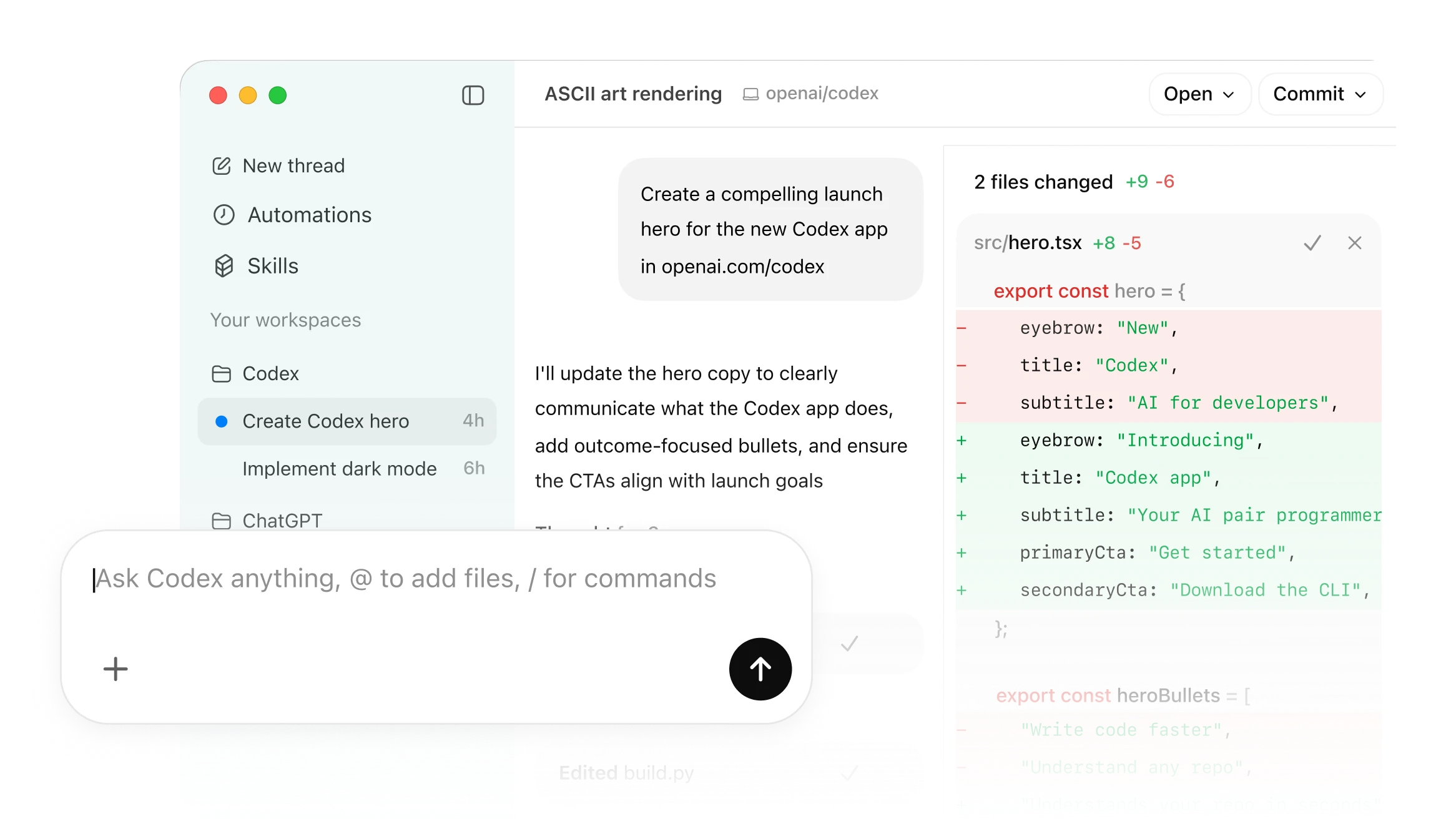
OpenAI released a new macOS Codex app designed to let developers run and manage multiple AI coding agents simultaneously.
Details
The app functions as a central command center for parallel, isolated agents across projects
“Skills” expand Codex beyond coding into deployment, project management, image generation, and automation
OpenAI demoed Codex autonomously building a full 3D racing game from a single prompt using ~7M tokens
Available on macOS only for now, with limited free usage and higher caps for paid users
Why it’s important
After losing developer mindshare to Anthropic, this is OpenAI’s strongest workflow-focused response yet, pairing top-tier models with tooling that supports real production use.

Google DeepMind launches Project Genie
What’s happening
Google DeepMind launched Project Genie, a web app that lets users explore AI-generated worlds in real time.
Details
Users prompt environments and characters, then explore them in first- or third-person
Worlds persist visually, maintaining spatial and environmental consistency
Sessions are capped at 60 seconds due to compute costs, with each session assigned a dedicated chip
Access is currently limited to Google’s $250/month AI Ultra subscribers
Why it’s important
World simulation has crossed from research demo to lived experience. As competitors race forward, reality-scale simulation is quickly becoming a foundational AI platform layer.